Introduction
The textile, clothing, leather, and footwear (TCLF) sector plays a crucial role in the European economy, but it is confronted with notable issues related to its environmental impact. As part of the GreenLift labs methodology and business plan project, we investigate how our efforts are turning these obstacles into chances for sustainable development.
The environmental challenge: why we must act
The textile industry is among the most resource-heavy sectors in the world. The significant use of water and chemicals in the dyeing process, along with the waste produced by fast fashion, clearly harms our natural ecosystems. Tackling these problems is not only essential for the environment, but also a fundamental goal for the future of manufacturing in Europe.
How GreenLift labs methodology and business plan addresses environmental challenges
The GreenLift labs methodology and business plan initiative operates under the belief that achieving a sustainable transition is not feasible without an equipped and knowledgeable workforce. We are diligently tackling the industry’s environmental footprint with a targeted approach:
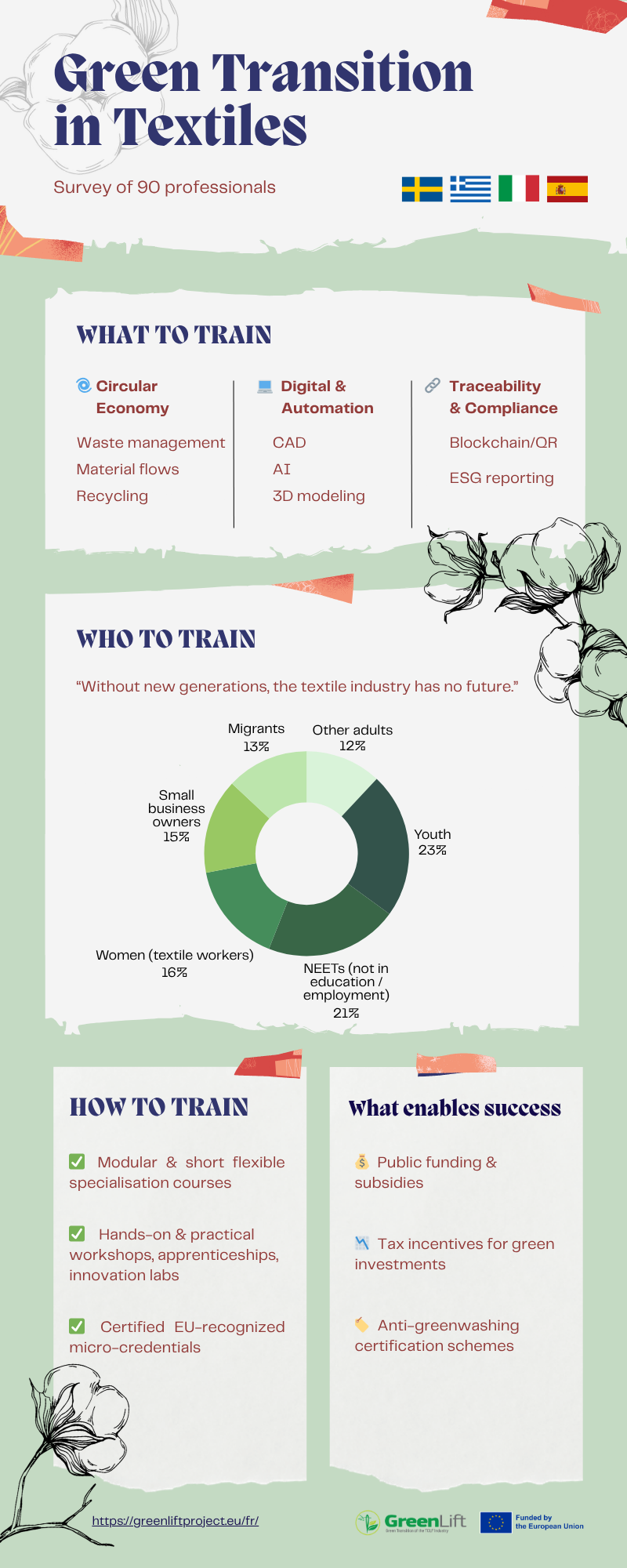
- Community-focused skills development. Environmental sustainability begins with the individuals at the forefront, nurturing a green mindset among workers and professionals alike. By providing training in modern, environmentally friendly production methods, we aim to reduce resource usage and minimize waste right from the beginning.
- Embracing circularity. Transitioning from a linear “take-make-dispose” approach to a circular economy lies at the core of what we aim to achieve. Our training modules equip TCLF professionals with the knowledge needed for life-cycle assessments, enabling better management of textile waste and the reintegration of recycled materials into production processes.
- Digital transformation & optimisation. Digital tools play a crucial role in promoting sustainability. With GreenLift labs methodology and business plan, we advocate for digital innovations like precision cutting and 3D prototyping. These advancements lead to a decrease in raw material consumption and a notable drop in the overall carbon emissions associated with production.
- Hands-on learning via GreenLift labs methodology and business plan labs. In addition to theoretical education, the GreenLift labs methodology and business plan initiative is creating a network of both physical and digital labs aimed at giving TCLF professionals practical experience. These GreenLift labs methodology and business plan labs act as the operational core of our project, where sustainability concepts are transformed into actionable steps. In these cutting-edge environments, participants have the opportunity to directly engage with circular design methodologies, sophisticated waste management strategies, and the incorporation of renewable energy solutions. By providing this immersive training setting, the project guarantees that the workforce is not only aware of environmental issues but also thoroughly equipped with the practical green skills necessary to effectively minimise the industry’s ecological impact.
Our unified commitment
As a group of partners from different regions of Europe, we are committed to bridging education with real-world industry demands. We are convinced that by providing the workforce with advanced green skills, we can help the European TCLF sector stay competitive while honouring the planet’s limits.
Conclusion
The textile industry’s impact on the environment is complex, but we can find solutions through teamwork and focused learning. With GreenLift labs methodology and business plan, we are not just discussing change we are preparing the people who will make it happen.